Analyzing Scholarship: Wulf and Eadwacer
In a poem that sits at just nineteen lines, one would likely expect there to be very little debate on its meaning, for obviously as modern readers we know every true story has a beginning and end. But for Wulf and Eadwacer this is not so. For one it has no action whatsoever, and is no doubt a lament. But the discourse on its meaning comes down not to the tone, but to the vague names of the characters and their actions.
During the nineteenth century, scholars began to finally appreciate the value of the poem, as well as the rest of the Exeter Book, but upon taking a look at transcriptions and Michael Alexander’s translation, followed by the original manuscript, I found there to be the most peculiar of emendations. Now, it is not uncommon for scholars to emend poems, but during the golden age of philology, scholars often thought of poets, especially Germanic poets, as dumber than, or more barbaric than the humans of today.
The largest emendation was of the hapax legomenon dogode to hogode. This, to put it simply, should not have been done, for one, what is arguably the most famous hapax legomenon in all of Old English is docga, meaning dog, while the most used words in the written corpus for canines were hund (modern-day hound), and wulf (modern-day wolf). So to change what likely meant doggedly, or like a dog, to hogode, meaning thought, or mulled over, is wrong. The definition is highly debated though. I lean towards the docga relation because of the heavy anthropomorphic setting. Many scholars, however, link it to either the Old Norse duga, being an anglicized spelling of dugða (which makes no sense because Old English also had the letter ð), or to some other extremely rare or vulgar Western Germanic verb. The latter is also very possible, but unlike Latin, we do not have thousands of years of vulgar and classical writing to compare to deduce the meaning.
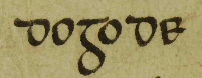
Dogode, as seen on f. 100v of the Exeter Book
So continuing, why change it? Well, the answer lies only with those past scholars, but, it may very well be that the thought of a word that they did not know; that, if meaning “like a dog,” would have changed the tone of the poem, deterred them so much that they replaced it with hogode to have the romanticized dark tone of the poem fit their mold. Now, as an individual poetry is supposed to mean whatever it resonates with to you, however, as scholars it is our job to preserve the text exactly as it is and only in footnotes add emendations to help readers make their own theories and decisions.
Looking at the paleography itself, the first D is what matters here. There is no erasure or signs of scraping, and it looks perfectly uniform with the the other D at the end of the word. For reference, here is what the scribe’s Hs look like.
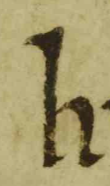
Obviously, nothing like the D.
Moving on, the other two major emendations come down to the characters themselves. Because this was written in the Insular Minuscule, there are no capitals except for the very first letter of the poem. Thus we see Eadwacer’s name printed as “ead wacer,” the name itself is a kenning meaning “property-watcher” or “wealth-watcher.” Now, it is not uncommon either for Anglo-Saxon characters to have such literal names. Beowulf for example is a kenning meaning “Bee-wolf,” which is a bear. But Beowulf’s name is not, in all of the Nowell Codex I’ve looked at, printed as two words; Eadwacer’s was. However, this does not mean that it is not a name, scribes frequently printed words based on how they sounded, it may be that Eadwacer’s name was pronounced as two words and not one by the scribe.
Then the words “se beaducafa.” The issue here is not what this means, it translates roughly to “the battle-bold one” or man as it is in the masculine nominative singular. The issue instead is who this refers to. Is it Wulf? her lover, or Eadwacer? whose role will be discussed in a moment. Truly, we can’t know, we have to infer here. But, based on the poem as a whole I argue it is Eadwacer as the poem moves from the narrator’s thoughts to her external voice at the end as she speaks to Eadwacer. This line is the turning point as the battle-bold man envelops her.
The next word is earne emended to eargne. These are two different words, both are documented. Earn means eagle, which fits the anthropomorphic storytelling so far of the poem. Wulf and their hwlep (whelp) are away, their whelp is earne (eagle-like) and swift. Eargne however, means cowardly, or inert, which fits the somber, lamenting tone that has been imposed. But I have faith that this expert scribe did not make five mistakes in just nineteen lines. I don’t know that this is the full story, he may have gotten bored, and simply decided to stop at a good, coherent point, and save his vellum to write other things.
Now the word hwlep. Many think of this as calling the child disgraceful or whatnot and translate that tone thus. However, many fail to realize, especially Michael Alexander, that whelp is another word for a baby dog, wolf, bear, and other animals. It is also a verb meaning when a dog or wolf gives birth. Therefore the meaning is almost certainly fitting the ongoing anthropomorphic theme, and not calling her child a disgrace and outlaw, though, there likely is double-meaning in that as Wulf is implied to be an outlaw.
Finally, the least important word to note, is aþecgan which is rarely emended, appears in the identical lines two and seven, and is translated as kill or devour. I have no argument on this, because it makes perfect sense in the context of the story.
The Story and Eadwacer’s Role
The story itself is basic, and very stationary, however, the depth is that of an iceberg. The narrator is a woman, likely unmarried, that is in deep longing for her lover, and child. Wulf, having impregnated a woman who is likely royalty to whatever clan or kingdom this is, has been outcast. Because of her love, he likely has not been killed, but instead exiled. In line three, she states that she is on one island, and Wulf on another. This geographically could be many places. Taken literally, he could be an Irish viking she fell in love with, or a Welshman form Ynys Môn, or a Viking from Orkney, a Scotsman from Skye, or even a Gael from the Isle of Man. Though, I lean towards Ireland, because she states that it is “fenne biworpen” (warped by fens). She then refrains for the second time “ungelic is us.” This can be translated as “different is our [fate].”
Now she moves to her present being. She states that it is raining, and that she is weeping near the hearth. She then states that the battle-bold man (Eadwacer), envelops her in his arms. This is where scholars in their interpretations, seem to lean towards romanticism and darkness. They read this gesture as him forcing himself upon her. That he is her captor/husband. However, she states that at first she felt happy. The word used is wyn, which is where we get the modern “win.” She then says that she then was loathsome of it. I do not believe she speaks of sexual pleasure, followed by longing. I believe that Eadwacer is a brother, a loving brother. For in Anglo-Saxon society, the protectors of a woman, went in order as father, brother, and then husband. If she ever went to her father or brother to tell them of this, if she ever wrote to them, or sent someone, they would have no doubt killed Eadwacer, though there may have been some political turmoil and consequences from this. So, Eadwacer is her brother, hugging her because he knows of her plight and her longing for her lover and the father of her child.
This is further affirmed in the final lines where she says that it was her longing that made her loathsome, implying the embrace itself was caring and loving, and that she did appreciate it, but that it was sorrowful, for it was not her Wulf. She then states, that it is his seldcymas (seldom comings) that make her loathsome and sick. This contradicts lines two and seven, saying they would kill him if he came. But here she states he has. Several, albeit rare, times. I believe the meaning here is that she is in pain because of the danger on his life he risks for him to see her. And that shall he come again, he surely will be killed.
She says after this, affirming, that hit is his comings which bring her into longing, and not the meteliste (hunger) that she spoke of. She obviously told him she longs for him and to be with him, but his life risking visits have only brought her further into longing and fearfulness for him.
Finally in what is the last stanza that is generally transcribed, she speaks to Eadwacer: “Gehyrest þu, Eadwacer? Uncerne earne hwelp bireð wulf to wuda.” (Do you hear, Eadwacer? Our aquiline whelp Wulf bears to the woods.)
Now whyever would a captive woman in a time where women were expected to listen and do as told, speak out to her captor about this longing and her child that he would no doubt hate. Not to mention he likely would not want to hear the talk of Wulf at all. If Eadwacer is her brother, then it is far more believable that she speaks to him and vents to him because she trusts him, and it is his role to protect her physically and emotionally.
The last two lines state: “Þæt mon eaþe tosliteð þætte næfre gesomnad wæs, uncer giedd geador.” (One easily tears apart that which was never united, our yed together.)
This no doubt refers to the legal state of Wulf and the narrator’s relationship. They were not wed, therefore her family could easily tear them apart. Had they been wed and legally bound together, her family would have had a much harder time legally breaking their marriage apart. Ultimately I do not believe Eadwacer is the one who made this decision, he may agree but he also wants his sister happy no doubt, based on the care he exhibits. It was likely her father who did so.
Ultimately it is still a sad story, but I do not believe it to be one of assault, and of the gothic fantasies imposed on it. However, one must recognize that as scholars it is our job to infer, for unless the poet tells us exactly what he meant, we can only theorize, and present factual information for the next generation of scholars to use for their theories.
